Last week, I spent the morning with the CIO and leadership team of a large global consumer goods company.
I had gone in to talk about some of the agentic solutions we have been implementing — what the implementation path looks like, the outcomes we are seeing, how these solutions mature once they move into production, and, importantly, what starts to go wrong when they meet the realities of day-to-day operations.
The company is also in the middle of a major SAP S/4HANA transformation across markets and entities. Its first phase went live in June 2026.
Over lunch, our conversation moved to how that rollout was progressing.
What I heard caught my attention.
A large share of the post-go-live effort wasn’t about fixing SAP. It was about helping people adjust to it.
New screens. New processes. Where to go. What to enter. Which sequence to follow. Training, adoption and supporting people who had been doing the same work differently for years.
There were configuration issues too, of course. But it was striking how much effort was going into helping people learn to operate the new system.
Later that afternoon, we visited an operations floor supporting another client.
I got to watch AR, AP and R2R teams working through real transactions. People moving between screens, checking information, referring to supporting documents, updating trackers, investigating exceptions and deciding what to do next.
As I walked around, I found myself thinking about the conversation over lunch.
How much of what I was watching required business judgement, and how much of it was simply knowing how to operate the software?
Take AP.
The person may know exactly what needs to happen with a blocked invoice. But getting there may still require knowing which SAP transaction to use, which fields to populate, where to look for supporting information and what steps to follow.
So I started wondering: what if the person only needed to understand the business problem and the decision — not every system step required to get there?
Instead of navigating through SAP, what if they could simply ask:
“Show me the invoices blocked for payment today, explain why they are blocked, and resolve the ones that don’t need my intervention.”
SAP doesn’t go away.
The invoice is still there. So is the purchase order, vendor master, approval rule, financial posting and control framework.
What may change is how much of SAP the employee actually needs to see.
Four thoughts stayed with me after that visit.
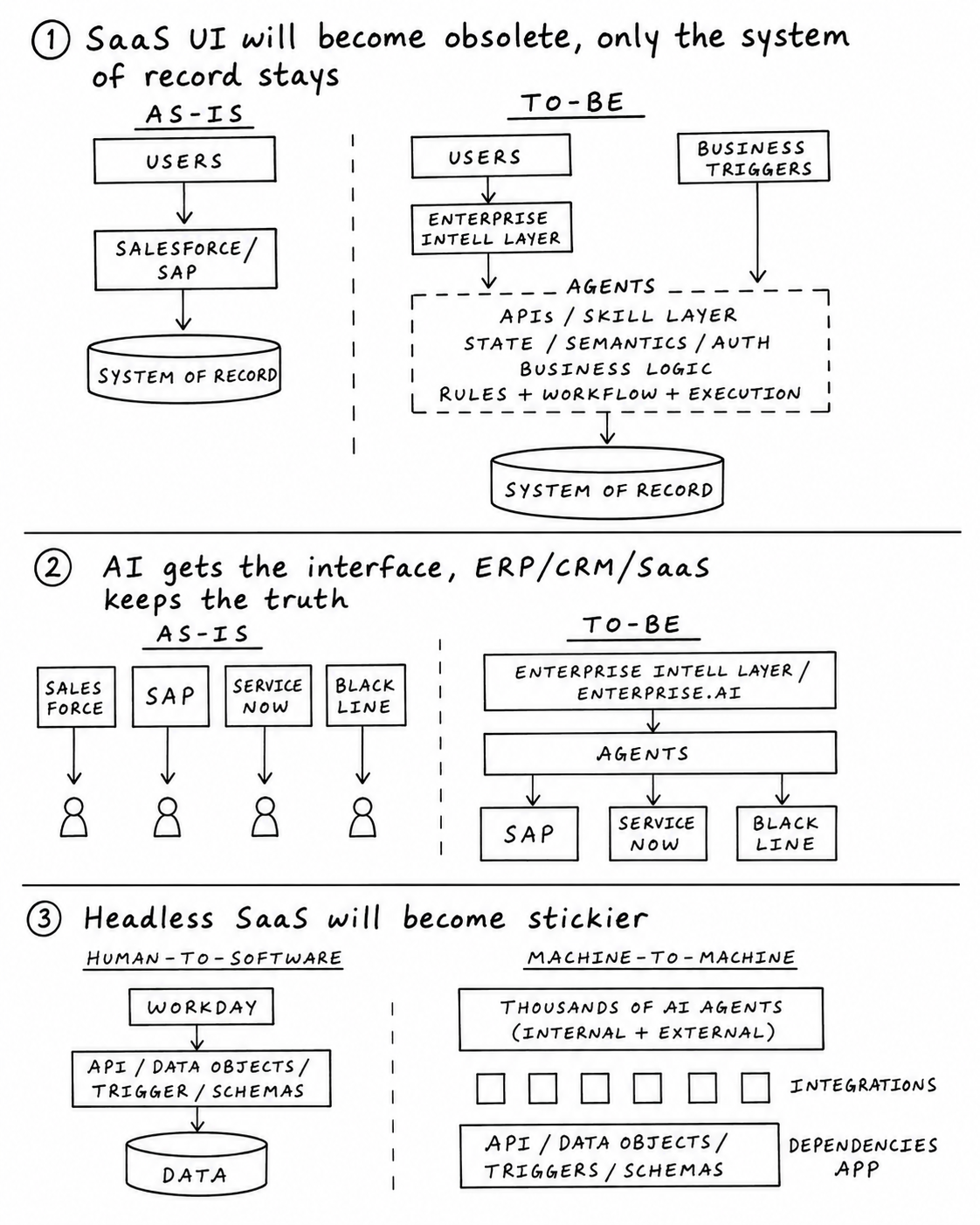
1. The interface can fade. The system of record cannot.
We tend to think of SAP, Salesforce, Workday and ServiceNow through their screens because that is how employees experience them today.
But their real value sits underneath.
SAP holds the invoice, purchase order and financial posting. Salesforce holds the customer and opportunity. Workday holds the employee record.
They also hold the rules around what can be changed, who can change it and what gets recorded when something happens.
Employees may eventually spend much less time navigating these applications directly.
But the underlying systems could remain just as important — possibly more so.
The interface may change. The truth underneath still has to live somewhere.
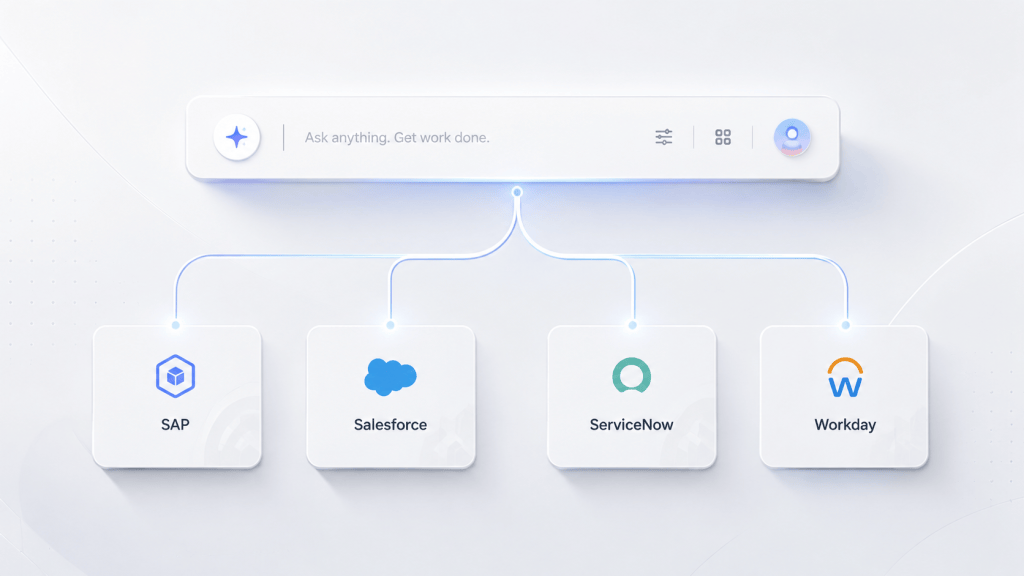
2. One interface could become the front door to several applications.
Today we largely work application by application.
Finance goes to SAP. Sales goes to Salesforce. HR goes to Workday. IT goes to ServiceNow.
That may not always be necessary.
Suppose someone asks:
“Show me customers with more than $1 million overdue and tell me which sales account owners I should contact.”
Part of the answer may come from SAP. Another part may come from Salesforce.
The employee doesn’t necessarily need to know that.
One interface could understand what the person is trying to accomplish and work with the applications underneath.
The applications still own the records and execute the transactions. What changes is who owns the employee’s starting point.
3. Less visible enterprise software could actually become harder to replace.
This one is slightly counter-intuitive.
If employees stop using the SAP or Salesforce interface directly, you might assume those applications become easier to replace.
I think there is a reasonable case for the opposite.
Today, replacing a major enterprise application already involves data migration, integrations, process changes and retraining people.
Now add thousands of automated processes that depend directly on that application’s APIs, data objects, workflows, triggers, schemas, permissions and business rules.
Those dependencies can become deeply embedded without most employees ever seeing them.
Replacing the application then means finding, rebuilding and testing those connections too.
So we could end up in a strange position where an application becomes less visible to people and more embedded in the company.
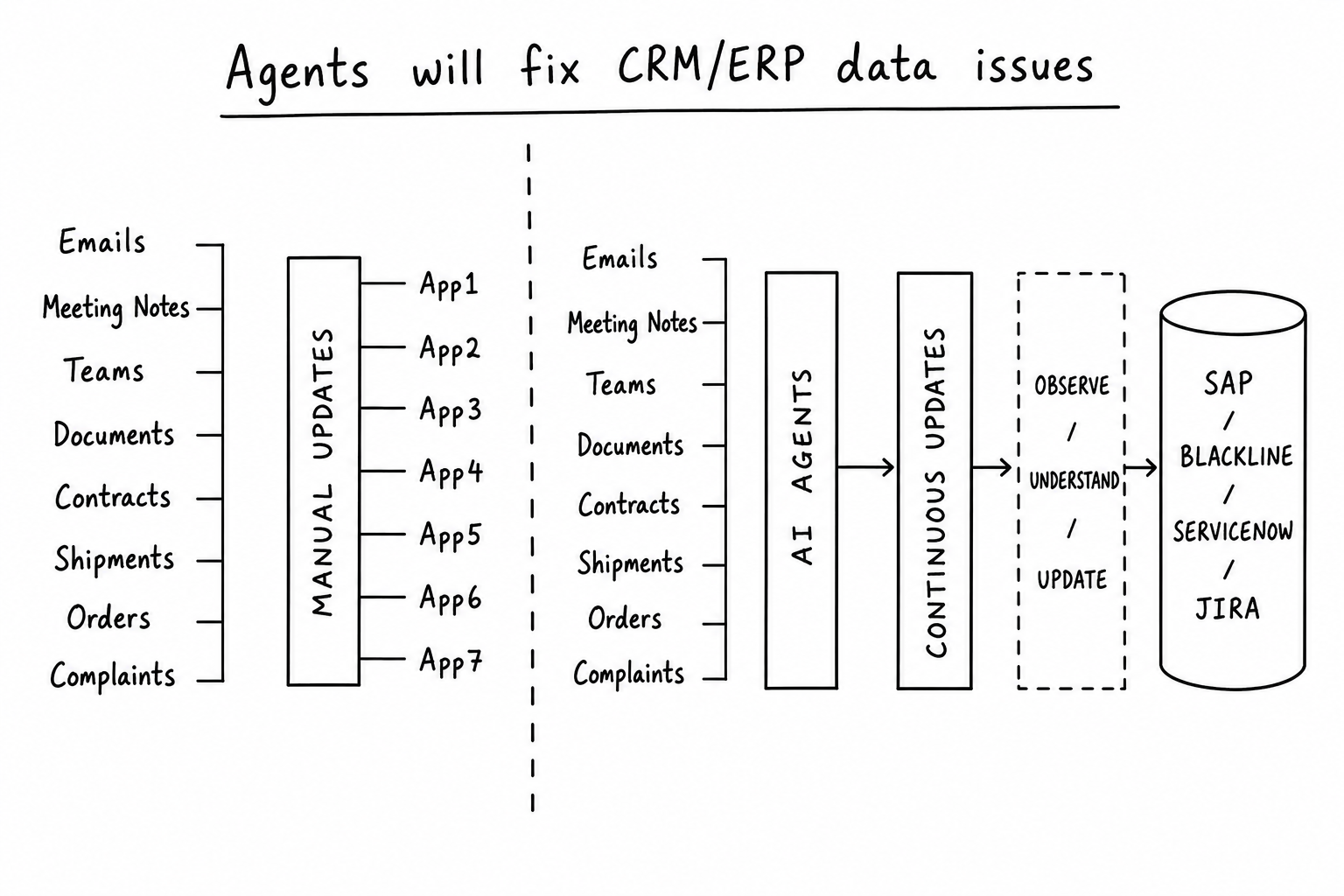
4. Less manual updating could actually improve the data in ERP and CRM.
The floor walk also reminded me how much operational context still sits outside the core systems.
In AP, teams may maintain Excel trackers containing blocked-invoice reasons, approvers, exception comments, expected resolution dates or GL and tax-code references.
Collections teams may track promise-to-pay dates, dispute reasons, deductions, customer responses, follow-up dates and next actions.
Add emails, Teams conversations, meeting notes, contracts, shipment information and supporting documents, and there is a lot of business context sitting around the ERP or CRM rather than inside it.
Today, someone has to interpret much of that information and manually put the relevant pieces back into the system.
Sometimes it happens late. Sometimes only part of it gets updated. Sometimes it doesn’t happen at all.
As more of this work becomes automated, those sources could be picked up as part of the process and the relevant information reflected back into SAP, Salesforce or ServiceNow, with people stepping in for exceptions, judgement and approvals.
That could produce an outcome I hadn’t really considered before:
people spending less time updating ERP and CRM systems, while those systems contain better information.
And that is what stayed with me after the visit.
I don’t think SAP, Salesforce, Workday or ServiceNow are about to become irrelevant.
I think something more subtle may happen.
We may see less and less of them while depending on them more and more.
For years, a big question in enterprise transformation has been:
How do we train thousands of people to use the new system?
The question I left with was slightly different:
Instead of asking how quickly people can adopt the new system, should we be asking how much of it they should ever have to see?


Leave a Reply